Get to know... André Fonseca
Learn about the work of our Integrated Members.
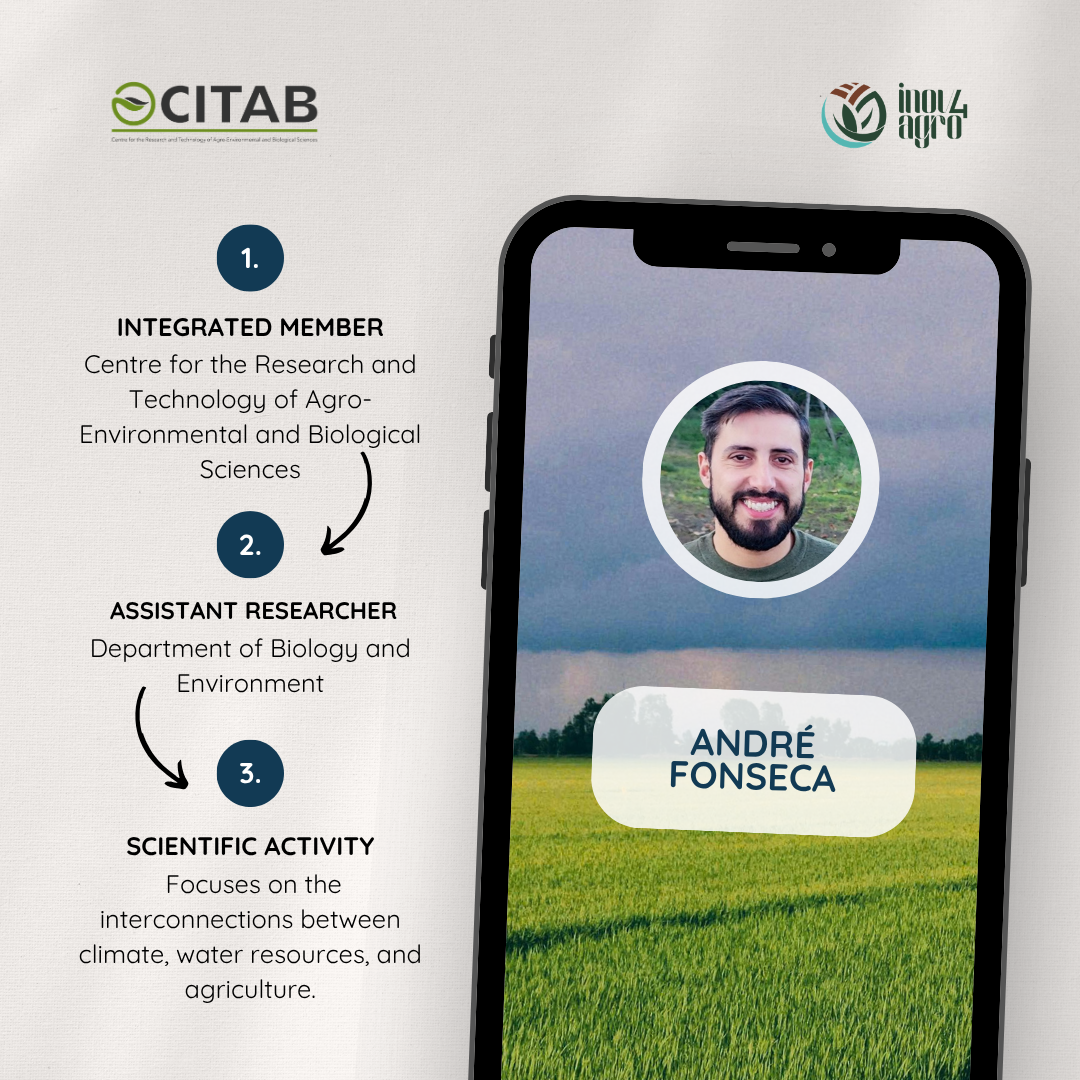
The research activity of André Fonseca focuses on the interconnections between climate, water resources, and agriculture, with particular emphasis on hydrological and climate modelling and the assessment of climate change impacts on agroecosystems. His work has contributed to the development of advanced methodologies for analysing climate variability and future projections, including geospatial downscaling techniques, bias correction approaches, and high-resolution microclimate modelling. These approaches have enabled the creation of detailed climatic datasets and supported the assessment of water availability, extreme events, and agricultural productivity under changing climate conditions. His research also addresses the quantification of uncertainties in environmental modelling and their implications for decision-making. More recently, his work has focused on viticulture, exploring how climate variability and extremes influence grapevine development, yield, and quality, while contributing to the design of decision-support tools adapted to local and regional scales.


He has been actively involved in several national and European research projects, contributing to the application of scientific knowledge in support of climate adaptation strategies and the sustainable management of natural resources. This includes participation in territorial planning, climate risk assessment, and watershed management initiatives, where hydro-climatic modelling supports evidence-based decision-making and public policies. Integrated within multidisciplinary teams at CITAB/UTAD, his activity also encompasses the supervision of undergraduate, master’s, and doctoral students, as well as the promotion of advanced training and knowledge transfer activities. This trajectory reflects a sustained commitment to producing robust and applied scientific knowledge, contributing to more resilient agricultural systems and to the sustainable management of water resources under current and future climate challenges.