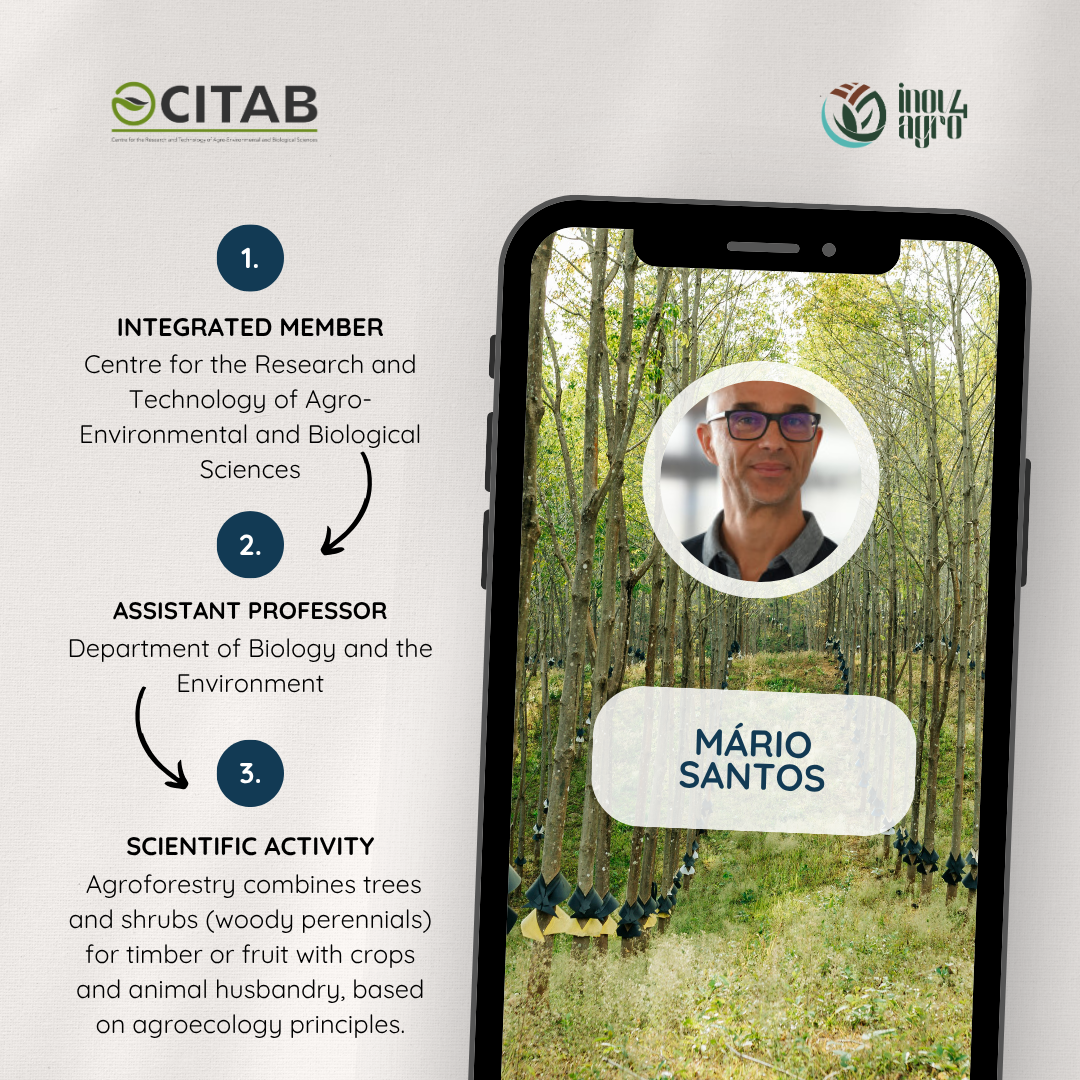
Get to know... Mário Santos
Learn about the work of our Integrated Members.
AGROFORESTRY SYSTEMS: ANCIENT TECHNOLOGIES FOR CONTEMPORARY CHALLENGES?


Agriculture and forestry are usually considered different areas of knowledge. Generally, agriculture is conceived as the science or practice of farming, including cultivation of the soil for the growing of crops and the rearing of animals to provide food, wool, and other products. On the other hand, forestry is perceived as the science and art of managing forests and woodlands for a variety of benefits, including timber harvesting, wildlife habitat, recreation, and environmental protection.
Reality shows that present-day agriculture and forestry, increasingly specialised and extensive, generate higher crop/raw materials yields and profitability, contributing with resources and food for a growing global population. Several technologies are presented as increasing efficiency and precision, usually associated with mechanisation and reduced labour costs. Nonetheless, practical experience highlights a number of environmental shortcomings, such as soil degradation and water pollution, habitat destruction, loss of biodiversity, vulnerability to pests and diseases, increased wildfire risk and a heavy reliance on non-renewable fossil fuels. Additionally, higher investments and technical challenges are associated with job displacement and economic challenges for small farmers.
“Agroforestry” was coined in 1973, but the concept includes practices that have existed for millennia. Agroforestry is a land use system that combines trees and (or) shrubs (woody perennials) for timber or fruit with crops and (or) animal husbandry, based on agroecology principles. Agroforestry can be considered a practice when linked to plot scale (silvoarable, silvopasture, homegarden, woody linear landscape strips, and forest farming), and a system when associated with the global farm scale. Although it has received limited recognition in agricultural regulations and policies (e.g. the European Common Agricultural Policy) and is often regarded as outdated by various actors, its benefits are increasingly acknowledged in the context of ongoing climate change and socio-environmental disruption.
Several studies demonstrate agroforestry environmental (1), productivity (2), economic (3) and social (4) benefits. These include: 1) a better utilisation of groundwater, a reduction in nutrient leaching and in soil erosion and the conservation of biodiversity; 2) might provide larger yields, greater resilience to droughts, floods, pests, and diseases, wind protection for crops and shelter for livestock; 3) diverse revenues (timber, firewood, fruits, and more), reduced inputs costs (pesticide and fertiliser use) and even sustainable practices grants; 4) improvement of the aesthetics of the farmland, well-being of communities and a more positive perception of agriculture by urban inhabitants.
Challenges for agroforestry implementation comprise: 1) ?; 2) shade and competition for nutrients and water and possible habitats for pests; 3) lower profitability when compared with monocultures, resource-intensive labour and higher operating costs, including a long-term commitment vs market fluctuations; 4) inherently more complex than monocultures, knowledge in selecting compatible organisms and higher level of expertise for actors.
CITAB researchers made a modest contribution to advancing knowledge of Agroforestry in Mediterranean ecosystems. More information can be found here.